Decolonizing the Digital
three Residencies in the framework of
Beyond Gravity Festival 2025
Beyond Gravity Festival is a festival between Digital Media and Performing Arts. In 2023 it happened the first time with a focus on dance and Virtual Realities. The program was developed from a preceding residency at Theater im Depot in which three projects have been developed.
The Festival presented eight artistic positions as well as a symposium with another three artistic-scientific presentations and seven scientific lectures. The festival in 2023 was a cooperation between Theater im Depot and the Academy for Theatre and Digitality.
In 2025 the festival will be a cooperation between the Academy for Theater and Digitality, Kulturforum Witten and Theater im Depot. Our new residency program is headlined with the title Decolonizing the Digital.
The three international curators Viviane Maghela (Cameroon), Marlon Barrios Solano (Venezuela/USA) and Laura Cugusi (Italy with an expertise in the southern Mediterranean) have been invited to develop a project together with an artist of their choice – Eric Takukam (Cameroon), Maria Luisa Angulo (El Salvador/France) and Nada Zanhour (Lebanon). These three project tandems are developing projects for which we are now inviting tenders for cooperation. We are mainly focusing on artists/developers from Ruhrgebiet/NRW.
KAM (noble)
Viviane Maghela (Curator) and Eric Takukam (media artist) from Douala/Cameroon
Viviane Maghela’s practice in an active decolonial process through research, colaboration, learning and bulding platfoorms aimed to re-inscribe histories and perspectives, which have been devalued through ‘radical exercises of un-thinking, de-disciplining, and re-educating. She is interested in projects that reach beyond the institution to embrace other spaces and communities.
Eric Takukam is a Cameroonian digital artist living in Douala. He works on the preservation of African cultural heritage through immersive and interactive artworks. His work also addresses issues related to mental health and ecology.
Background
In a world full of uncertainty, complexity and ambiguity, the interactions and exchanges between different disciplines are fundamental to achieving a relational approach that responds to the environmental, political, social, economic and technological issues we must address today.
The process of decolonizing knowledge and technologies begins by decentralizing and including a greater diversity of experiences and perspectives. New categories and epistemologies need to be invented or old ones reinvented.
Whose stories haven’t been told and what technological ways unimagined, labelled wild and rendered invisible, known to few other languages, cultures and territories, but to themselves? The visual representations of African identities and spaces have often been distorted and misappropriated by colonial legacies and they continue to evolve in contemporary society.
Entire indigenous cultures die out, languages get forgotten, literatures disappear. Unique stories remain untold and unheard, experiences remain unshared: What role do technologies play in reproducing power disbalances and how could such technologies be used as means of political participation?
What's the plan?
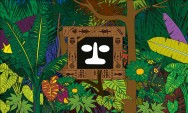
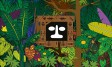
The plan is to develop a playful installation that immerses the visitors in an interactive setting. In its core stands a character that represents the development of a character from the Bamilekè culture – from a child to a Nekang dancer to the FO’O (a principal figure). The work is meant to be an audiovisual installation that integrates AI-driven image generation, visual programming and interactive technologies. A focus of the joint development would be to develop a visitor oriented interactive narration as the core element of the installation.
Residency Partnership
Through an open call, the team sought a technically skilled individual from North Rhine-Westphalia – an artist or developer who was interested in co-developing the outlined project, with a particular focus on artistic and technical development.
This is how Enya Obert (digital artist and developer) from Essen joined the project in early 2025. Take a look at what the three of them have achieved here.
Everything is Computer
Laura Cugusi (Curator, Italy) & Nada Zanhour aka machine yearning (Lebanon)
Laura Cugusi
Laura Cugusi is an artist, writer, researcher and producer. Her practice is nomadic across languages, disciplines, and media. Her recent work focused on mapping media ecologies, techliteracies, governance infrastructures and institutional world-building strategies that shape and consolidate the imagination (or lack thereof) about the future.
Nada Zanhour
Lebanese, living on the internet nȼӿ੩ ੩ aka machine yearning aka Nada Zanhour works across sound, video, 3D and interactive media. She has many other monikers, selves and multiplicities.
Background
The project explores how AI aesthetics, predictive simulations, and strategic scenario planning shape dominant narratives of the future—narratives that tend to align with corporate, military- industrial, and colonial logics. Drawing from speculative design, critical infrastructure studies, and decolonial theory, the project investigates how emerging technologies perpetuate or challenge the dominant imagination of the future..
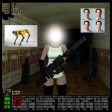
We are particularly interested in the role of game design and interactive fiction as narrative models that diverge from linear storytelling. The form of the project is a “game essay”—an exploratory digital experience in which players navigate a constructed environment and encounter fragments of text, voiceovers, archival materials, and algorithmically generated content. The final piece will encourage reflection and immersion over completion, open-ended navigation over resolution.i
What's the plan
We are a researcher-writer and an artist currently developing a collaborative project that interrogates the politics of future-making through the lenses of planned obsolescence, algorithmic control, and technologies of life and death. This work will unfold over the coming months as part of a research-based digital art residency and culminate in a hybrid exhibition (digital and spatial installation).
We are now looking to collaborate with a computer scientist, developer, creative technologist interested in the intersection of narrative design, tech development and critical theory, to join us in building a non-linear, interactive exploration game environment.
The project engages with game engines, machine vision, and generative AI, both as tools and as conceptual material, in order to examine dominant techno-scientific narratives and speculate on parallel trajectories around the future of science and technology.
Residency Partnership
Through an open call, the team sought a technically skilled individual from North Rhine-Westphalia or Germany – an artist or developer who was interested in helping to develop the outlined project, with a particular focus on artistic and technical development. This is how Federico Zurani (artist and game designer) joined the team in mid-2025.
Take a look at what the three of them have achieved here.
Pangea IA
in latent Space
María Luisa Angulo und Marlon Barrios Solano
María Luisa Angulo is a franco-salvadoran artist-researcher and economist, trained in contemporary dance, she holds a Master’s degree in Development Economics (La Sorbonne–Paris) and a Master’s in Art and Technologies (ArTec) from the Paris Research School (Universities of Paris 8 and Nanterre). Her career focuses on research-creation, exploring the intersections between art and technologies from a decolonial perspective. She is the founder of TRIAS CULTURE (Dakar–Paris), a platform through which she leads numerous digital art projects in various countries across West Africa and Latin America. In 2023, she co-founded the Pangea IA collective with artist Marlon Barrios Solano, with whom she investigates the relationships between the body, dance, and artificial intelligence. She is currently affiliated as an artist-researcher with the Center for Art,Migration and Entrepreneurship at the University of Florida (USA).
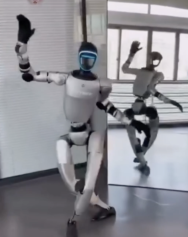
Marlon Barrios Solano is a Venezuelan–US interdisciplinary artist and researcher with a background in dance, cognitive science, and software engineering. His work explores the relationships between generative artificial intelligence, dance improvisation, cognition, and mindfulness. He develops interactive applications, installations, and performances, investigating the use of AI in the field of embodied cognition.
He is the creator of Sati-AI, an AI-powered Buddhist meditation coach, and works as a generative AI researcher with Wisdom Labs (San Francisco). He has been an artist-in-residence at Lake Studios Berlin, ICK Amsterdam, and Radiona (Zagreb). In 2023, he co-founded the Pangea IA Collective with Franco–Salvadoran artist-researcher María Luisa Angulo, with whom he explores the intersections of body, dance, and artificial intelligence from a decolonial perspective. He is currently Maker-in-Residence at the Center for Arts, Migration, and Entrepreneurship (CAME) at the University of Florida (USA).
Proposal
More than a final work, we propose a continuous research-creation process, mirroring the invisible tectonic drifts that sustain the deep and perpetual heartbeat of the continents.
In this latent space, each encounter is an infinite possibility for collaboration, another stage in this expanding geography, where knowledges, bodies, and technologies intertwine as living metaphors, tracing sensitive, plural, and decolonial cartographies.
Phase I: Preparation (January to July 2025)
Since January 2025, we have initiated dialogues with the organizers to align our proposal with the vision of the festival and the residency program. To date, this stage has included defining logistical, technical, and contractual aspects, as well as exploring possible formats and collaborations.
In parallel, we developed an initial bibliographic compilation and reflected on potential formats for the artistic and conceptual proposal. This process has benefited from a residency facilitated by CAME-UF (April 2025), which was extended in a self-managed way during June and July. During this phase, we were able to advance in the overall design of the project, the identification of possible technological solutions, collaborators, and contributors for the publication accompanying our process.
Phase II: On-site Residency (August 3 – September 30, 2025)
During this phase in Dortmund, we will work directly on the development of the installation, adapting it to the space, the local context, and the festival’s audiences. We envision this stage as a living laboratory, which will include collaborations with guest artists who will join our process during the last two weeks of September and continue through the festival in October. The laboratory will include an Open Studio format with two sessions : one at the end of August and another at the end of September, to share the process with the local community.
Phase III – presentation at the Beyond Gravity Festival (October 2025)
The proposal will take public form as a series of interactive installations, performances, lecture-performances, choreographic activations, workshops, and conversations with the audience. The main conceptual axes identified at this stage of the process are:
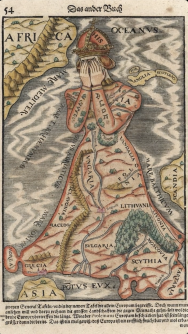
• Speculative Cartographies: Maps that imagine possible worlds, from a moving Pangea, questioning hegemonic narratives and proposing pluriversal perspectives. We ask: What if Europe had never existed? What would the peoples of a shifting Pangea look like? These cartographies emerge as performative acts that challenge dominant stories and trace lines of flight toward the pluriverse.
• Hybrid Cognitive Ecologies: Inspired by Lynn Margulis, we engage with AI as a form of mycelial intelligence and symbiotic ally, to imagine migrant, fungal, and relational identities.5
• Embodied Memories: Performance becomes a political gesture, where the body is an archive—a space of historical memory through which we recreate the speculative pasts of our stories erased by hegemonic narratives.
• Pangea as a Living Metaphor: An imaginary continent where multiple knowledges, languages, and affections converge. A pluriversal Pangea, a territory in dispute—open and mutable. A map that never coincides with the territory, where each artistic practice opens cracks in colonial certainties.
Our proposal arises from an urgency: in the face of advancing techno-apocalyptic and exclusionary narratives, we invite the imagining of sensitive and collective ways of cohabiting the future, where AI is not a god, but an ally in the creation of possible worlds.